
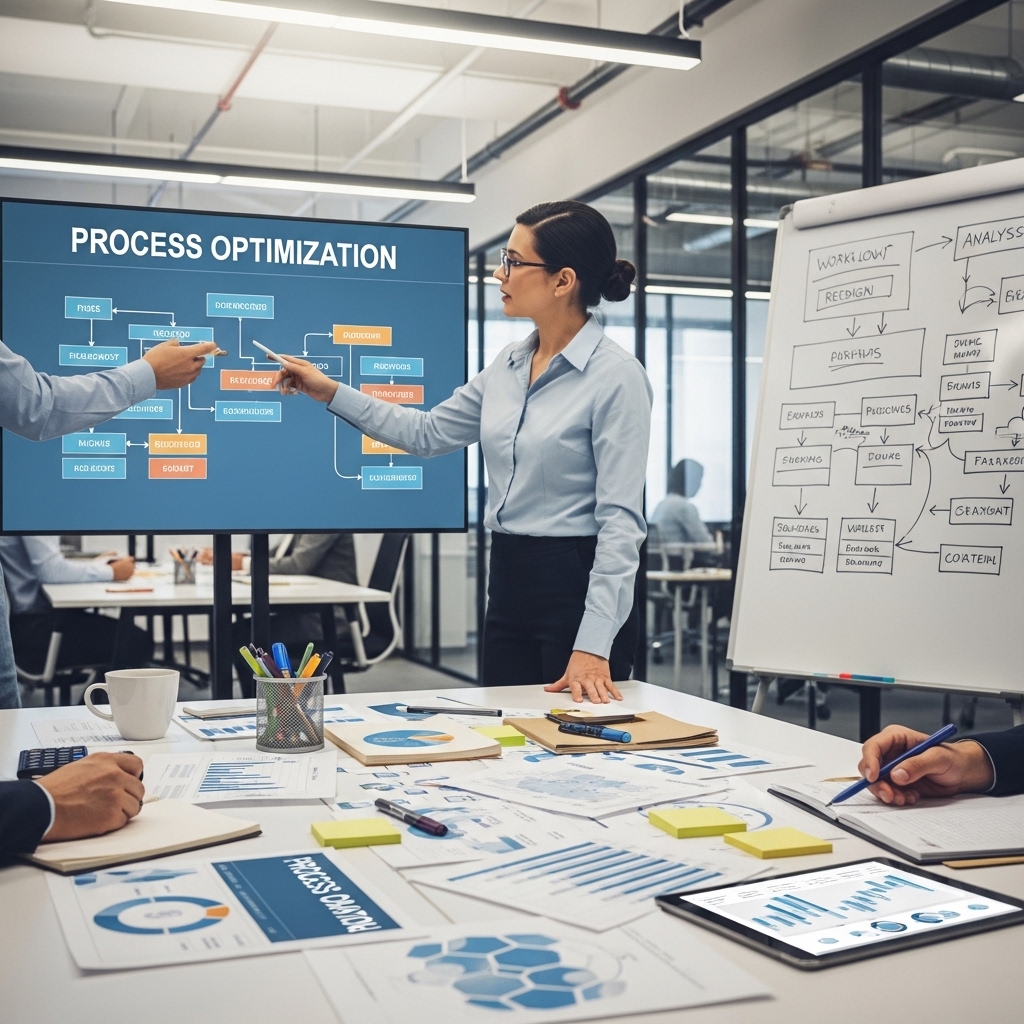
Process Improvement Workshop Kit
⚙️ Every Process That Hasn’t Been Deliberately Designed Has Been Accidentally Designed. The Accident Is Rarely Optimal.
Professional services firms accumulate processes the way cities accumulate infrastructure: through successive additions and modifications that made sense in their specific historical context, none of which were designed with the complete system in mind. The proposal development process grew from what one partner did well in the early days. The client onboarding process is a palimpsest of improvements added after specific problems emerged. The invoicing and collections process reflects the preferences of the financial administrator who designed it three years ago under different business conditions. The knowledge management process is whatever the current team invented to solve a problem they were experiencing, layered on top of what the previous team invented.
The result is that most professional services firm processes are functional rather than optimal: they produce the output they are supposed to produce, but at a cost in time, quality, and effort that a deliberately designed process would not require. And because the process problems are diffuse and chronic rather than acute and dramatic, they are rarely prioritized for improvement.
The Process Improvement Workshop Kit is a complete digital system for running structured process improvement workshops that identify, analyze, and redesign the specific processes in a professional services firm that are consuming disproportionate cost, producing disproportionate quality variance, or creating disproportionate friction for clients, team members, or both.
📦 Full Kit Contents
Digital-only. Instant download includes:
Process Improvement Methodology Guide (.pdf, 44 pages) A comprehensive reference for professional services process improvement practice:
Section 1: The Process Improvement Framework (10 pages) The complete methodology: DMAIC (Define, Measure, Analyze, Improve, Control) adapted for the professional services context, where many processes are knowledge-work processes that resist traditional industrial process improvement techniques. Covers: what makes professional services processes distinctive (judgment-intensive, relationship-dependent, expertise-variable), how to apply process improvement discipline to work that cannot be fully standardized, the specific process improvement techniques that transfer well from manufacturing and operations to professional services (value stream mapping, the eight waste categories, process FMEA), and the techniques that require adaptation.
Section 2: Process Selection and Prioritization (10 pages) How to identify which processes to improve first. Covers: the process inventory methodology (how to catalogue all significant processes in a professional services firm), the process performance assessment (how to evaluate each process against cost, quality, speed, and experience criteria), the prioritization matrix for ranking improvement opportunities by impact and feasibility, and the specific processes that most commonly deliver high improvement ROI in professional services firms (client onboarding, proposal development, invoicing and collections, knowledge management, and new employee onboarding are the five highest-frequency improvement targets).
Section 3: Process Analysis Techniques (12 pages) The analytical tools for understanding how a process currently works and why it performs the way it does. Covers: process mapping methodology (the specific mapping approach for knowledge-work processes, distinguishing between the formal process and the actual process that is being followed), the value-added analysis (separating the steps that create client value from the steps that exist only to manage internal needs), the waste identification framework (the eight categories of waste adapted for professional services: waiting, over-processing, defects and rework, unnecessary motion, over-production, knowledge loss, miscommunication, and underutilized expertise), and root cause analysis for process problems.
Section 4: Process Design and Improvement Techniques (12 pages) The creative and analytical work of designing better processes. Covers: process redesign principles for professional services (how to balance standardization with the flexibility that knowledge work requires), the technology enablement assessment (identifying where automation or digital tools can improve process performance without sacrificing quality), the process documentation standard (how to document a redesigned process so it is actually followed), change management for process improvement (how to get process adoption rather than process documentation), and the process control mechanisms that sustain improvement.
Workshop Facilitation Guides (.pdf, 5 workshop designs) Five complete process improvement workshop designs:
Workshop 1: Process Inventory and Prioritization Workshop (Half Day) The discovery workshop that produces the firm’s process improvement backlog. Facilitation guide covers: the structured brainstorming exercise for surfacing all significant firm processes, the rapid assessment exercise for evaluating each process against key criteria, the prioritization vote and matrix analysis for selecting the top three to five improvement priorities, and the improvement project charter for each selected process.
Workshop 2: Current State Process Mapping Workshop (Full Day) The analytical workshop that produces an honest, accurate map of how a selected process currently works. Covers the specific facilitation methodology for extracting the actual process (which frequently differs from the formal process) from a group of practitioners who perform it.
Workshop 3: Root Cause Analysis Workshop (Half Day) The diagnostic workshop that identifies why the current process has the problems it has. Uses structured root cause analysis techniques adapted for professional services process contexts.
Workshop 4: Future State Process Design Workshop (Full Day) The design workshop that produces the improved process. Uses structured ideation and evaluation methodologies to generate design alternatives and select the best-performing option.
Workshop 5: Implementation Planning and Control Workshop (Half Day) The planning workshop that translates the designed process into an implementation plan with specific actions, owners, timelines, and the control mechanisms that sustain the improvement.
Process Mapping and Analysis Toolkit (.pdf + editable .vsdx/.drawio templates) A complete visual process documentation system: current state process map templates (organized by professional services process type), future state process map templates, value-added analysis overlay template, RACI matrix template for process responsibility documentation, and process FMEA (failure mode and effects analysis) template.
Professional Services Process Library (.pdf, 38 pages) A reference library of the 18 most commonly improved processes in professional services firms, each documented with: a baseline process map, the most common failure modes and their root causes, improvement approaches that have produced documented results, the typical improvement impact (time reduction, quality improvement, cost reduction), and the change management considerations specific to each process type. Processes covered include: client onboarding, proposal and RFP response, engagement planning and kick-off, status reporting and communication, deliverable review and quality control, time recording and invoicing, collections, talent acquisition and interviewing, new employee onboarding, performance review, knowledge capture and management, client feedback and satisfaction measurement, and six additional high-frequency professional services processes.
Process Improvement Tracking and Governance System (.xlsx) An operational system for managing a portfolio of process improvement projects: project register with owner, status, and impact metrics, the benefits realization tracking for each completed improvement project, the process performance dashboard comparing current performance against baseline and target, and the process improvement program governance framework.
📂 What Lands in Your Download
📖  Process Improvement Methodology Guide (.pdf, 44 pages)
      DMAIC for professional services | process selection | analysis techniques | design principles

🎯  Workshop Facilitation Guides (.pdf)
      5 complete workshop designs | inventory and prioritization | current state mapping | design and planning

🗺️  Process Mapping and Analysis Toolkit (.pdf + templates)
      Current and future state maps | value-added analysis | RACI | process FMEA templates

📚  Professional Services Process Library (.pdf, 38 pages)
      18 commonly improved processes | baseline maps | failure modes | improvement approaches | impact data

📊  Process Improvement Tracking System (.xlsx)
      Project register | benefits realization tracking | performance dashboard | governance framework
Reviews
There are no reviews yet.